Insurance Payment Processing Solutions: Modernizing Premium Collection and Claims Disbursement
Insurance carriers face mounting pressure to modernize payment infrastructure. Legacy systems built for check processing cannot meet demands of digitally native policyholders or support emerging business models like embedded insurance and usage-based policies. Insurtech startups with frictionless payment experiences are capturing market share while traditional carriers struggle with outdated technology.
Insurance carriers face mounting pressure to modernize payment infrastructure. Legacy systems built for check processing cannot meet demands of digitally native policyholders or support emerging business models like embedded insurance and usage-based policies. Insurtech startups with frictionless payment experiences are capturing market share while traditional carriers struggle with outdated technology.
The Business Case for Payment Modernization
Digital payment processing reduces costs by 70 to 85 percent per transaction compared to check processing, while delivering measurably higher policy retention rates and improved customer satisfaction scores [1]. Yet 60 percent of U.S. premium payments are still collected via check or traditional bank transfer, representing significant untapped efficiency gains [2].

Automated Recurring Payments and Premium Collection
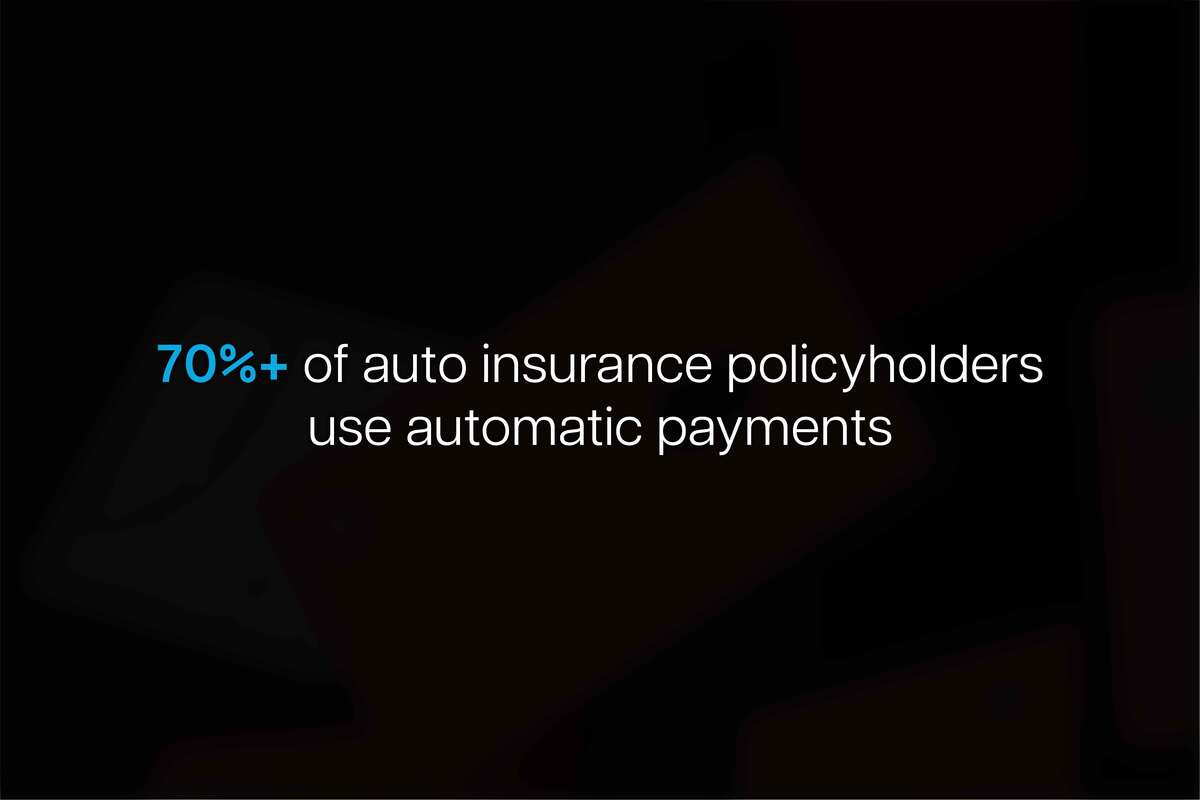
More than 70 percent of auto insurance policyholders now use automatic payment methods, with similar adoption in homeowners and renters insurance [3]. The business impact is substantial:
- Policy retention improves 15 to 25 percent with automated payments [4]
- Failed payment recovery increases 30 to 40 percent through intelligent retry logic [5]
- Administrative costs decrease significantly
- Cash flow predictability improves with scheduled collection
Essential Platform Capabilities
Modern recurring payment platforms should provide:
- Automated account updating for expired cards
- Intelligent retry optimization based on decline codes
- Payment method backup and cascading
- Real-time payment notifications
- PCI DSS Level 1 compliance with tokenization
Premium Financing and Flexible Payment Options
The premium finance market is growing 8 percent annually through 2028 [6]. Buy Now, Pay Later (BNPL) models are emerging for high-value policies, with platforms offering integrated installment options [7].
BNPL Business Impact
- Policy conversion rates increase 20 to 30 percent [8]
- Average policy values increase as payment burden spreads
- Younger consumers show strong preference for installment options
- Commercial buyers preserve working capital

Digital Wallets and Contactless Payments
Approximately 45 percent of insurance customers prefer digital payment methods, with higher adoption among policyholders under 45 [10]. Major carriers accept Apple Pay, Google Pay, and other digital wallets for premiums and claims.
Key Benefits
- Higher authorization rates through enhanced security
- Payment processing in seconds versus days
- Lower fraud rates via tokenization and biometrics
- Increased agent productivity with mobile POS systems

Real-Time Claims Payment
Major carriers have implemented instant claims payment systems disbursing funds within minutes rather than days [14]. Customer satisfaction scores increase 20 to 30 points with instant payment, directly improving retention [15].
Account-to-Account Payments
A2A payment methods bypass card networks, reducing transaction costs 50 to 70 percent compared to credit cards [16]. European carriers have successfully implemented A2A as primary premium collection, with U.S. adoption accelerating through FedNow and RTP networks.
Quantified Business Impact
Cost Reduction
Digital payment processing costs $0.50 to $1.50 per transaction versus $4 to $8 for paper checks, representing 70 to 85 percent savings [17]. Additional benefits include:
- Payment errors decrease 90+ percent through automation
- Accounts receivable staffing reduces 30 to 50 percent [18]
- Days sales outstanding improve 3 to 5 days [19]
Policy Retention Impact
Policyholders with automated payments are 40 percent less likely to lapse [20]. Net Promoter Scores increase 12 to 18 points with multiple payment options [21]. Customer service inquiries decrease 25 to 35 percent with self-service payment management [23].
Risk Management and Compliance
Payment Fraud Prevention
The insurance industry loses $80 billion annually to fraud [24]. Modern payment platforms employ multiple fraud prevention layers:
- Device fingerprinting to prevent account takeover
- Behavioral analytics detecting unusual patterns
- Machine learning scoring payment risk in real time
- Multi-factor authentication for high-risk transactions

PCI Compliance and Data Security
Organizations processing payment card data must maintain PCI DSS compliance through secure infrastructure, tokenization, strong access controls, and regular security testing [26]. Most carriers reduce compliance burden by using third-party processors that handle card data.
Regulatory Requirements
Insurance payment processing must comply with state insurance regulations, GLBA privacy laws, PCI DSS standards, CFPB consumer protection rules, and state-specific surcharging regulations [27][28].
Implementation Priorities for 2025–2026
AI-Powered Payment Optimization
AI-driven systems will predict payment failures, recommend optimal timing, and automate retry strategies. Carriers using predictive models reduce involuntary lapses 15 to 20 percent [29].
Real-Time Claims Payment
Instant payment capabilities through FedNow and RTP will become competitive differentiators. Fast claims payment drives higher retention and customer lifetime value [30].
Embedded Insurance Integration
The embedded insurance market will reach $722 billion by 2030 [31]. Successful implementations require API-first architecture, sub-second authorization, and white-label payment experiences.
Phased Implementation Roadmap
- Phase 1: Automated recurring payments and digital wallet acceptance
- Phase 2: Flexible payment plans and BNPL options
- Phase 3: Instant claims payment for simple claims
- Phase 4: API infrastructure for embedded insurance
- Phase 5: AI-powered optimization and fraud prevention
Selecting Payment Technology Partners
When evaluating providers, prioritize:
- Deep insurance industry expertise
- PCI DSS Level 1 compliance and security controls
- Comprehensive fraud prevention tools
- Flexible API architecture
- Transparent pricing with no hidden fees
Conclusion
Payment modernization is a strategic imperative for insurance carriers. Digital processing reduces costs 70 to 85 percent, improves retention 15 to 40 percent, and increases customer satisfaction measurably. Insurtech competitors with frictionless payment experiences are capturing market share from traditional carriers constrained by legacy systems. Insurance executives who prioritize payment infrastructure will position their organizations for competitive advantage through 2026 and beyond.
References
- Deloitte, "Insurance Payment Processing Efficiency Study," 2024
- McKinsey & Company, "Digital Transformation in Insurance Payments," 2024
- J.D. Power, "Insurance Payment Preferences Survey," 2024
- Insurance Information Institute, "Impact of Automated Payments on Policy Retention," 2024
- Stripe, "Failed Payment Recovery in Subscription Businesses," 2024
- Allied Market Research, "Premium Finance Market Forecast 2024-2028," 2024
- Insurance Technology News, "BNPL Options Emerge for Insurance Premiums," January 2025
- RevitPay, Embedded Finance and Flexible Payment Models: Industry Trends and Outlook, 2024
- Insurance Thought Leadership, "Usage-Based Insurance Payment Processing Requirements," 2024
- Accenture, "Digital Wallet Adoption in Insurance," 2024
- National Association of Insurance Commissioners, "Mobile Payment Trends in Insurance," 2024
- Insurance Innovation Reporter, "Cryptocurrency Payment Acceptance in Insurance," February 2025
- Juniper Research, "Embedded Insurance Market Projection," 2024
- Insurance Business America, "Real-Time Claims Payment Implementation," 2024
- Bain & Company, "Insurance Customer Experience and Payment Satisfaction," 2024
- FIS Global, "Account-to-Account Payments in Insurance," 2024
- American Bankers Association, "Payment Processing Cost Analysis," 2024
- PwC, "Insurance Operations Automation Benefits," 2024
- Treasury Management International, "Cash Flow Benefits of Electronic Payments," 2024
- Insurance Research Council, "Payment Method Impact on Policy Retention," 2024
- Bain & Company, "Insurance Customer Experience and Payment Satisfaction," 2024
- LIMRA, "Millennial Insurance Purchasing Preferences," 2024
- Gartner, "Self-Service Payment Management Impact on Customer Service," 2024
- Coalition Against Insurance Fraud, "Insurance Fraud Statistics," 2024
- Insurance Fraud Bureau, "Claims Payment Fraud Prevention," 2024
- PCI Security Standards Council, "PCI DSS Compliance Requirements," 2024
- National Conference of Insurance Legislators, "State Insurance Payment Regulations," 2024
- Consumer Financial Protection Bureau, "Payment Processing Regulations," 2024
- Forbes, "AI in Insurance Payment Optimization," 2025
- Federal Reserve, "Instant Payment Infrastructure and Insurance," 2024
- CB Insights, "Embedded Insurance Market Analysis," 2025
- EY, "Insurance Payment Technology Partnership Trends," 2024
Questions related to this guide
How much are credit card processing fees?
Credit card processing costs most U.S. businesses between 1.5% and 3.5% per transaction. The floor is interchange — the card networks' published wholesale cost — plus your processor's markup. Online and keyed transactions cost more than in-person chip payments because card-not-present fraud risk is priced into the rate.
Read full answerWhat is a merchant account?
A merchant account is the arrangement with an acquiring bank and a payment processor that lets a business accept credit and debit cards. Card sales are authorized and settled through it, fees are deducted, and the funds are deposited to your business checking account, typically within 1–2 business days. Approval involves underwriting, because the bank takes on risk for every sale.
Read full answerWhat is a payment gateway?
A payment gateway is the software that securely captures card details on your website or app, encrypts them, and sends them to the processor for authorization — the online equivalent of the card terminal in a store. Gateways also handle recurring billing, tokenization, and fraud screening before a transaction ever reaches the networks.
Read full answerWhich industries are considered high-risk?
Commonly high-risk industries include CBD and hemp, firearms and ammunition, nutraceuticals and supplements, telehealth, vape and tobacco, subscription and continuity billing, travel, coaching and info products, debt services, adult products, and pawn. Most appear on the published restricted-business lists of Stripe, PayPal, and Square — which is why those providers decline them.
Read full answerWhat documents do I need to apply for a merchant account?
A standard merchant account application asks for a government-issued ID, your EIN or business registration, a voided check or bank letter for your settlement account, and about three months of recent bank or processing statements. High-risk businesses should also expect to provide licenses, supplier agreements, and financial statements.
Read full answerCan gun shops and FFL dealers accept credit cards?
Yes. Gun shops and federal firearms licensees (FFLs) can accept credit and debit cards, and Visa says it serves any legal purchase. Paying by card does not change the dealer's federal duties: record the sale on ATF Form 4473 and contact NICS before transfer. The harder part is finding an acquiring bank willing to board the business.
Read full answerWhat is a chargeback?
A chargeback is a card payment taken back by the cardholder's bank after the cardholder disputes it. The issuing bank sends the dispute through the card network to the merchant's bank, which deducts the amount from the merchant's account. Visa's merchant rules call this a dispute. Mastercard calls it a chargeback. The process is the same.
Read full answer