Text-to-Pay vs. Email vs. Portal: Which Payment Request Actually Gets Opened?
Text-to-pay gets payment requests opened and paid faster than email invoices or customer portals because it arrives on a channel people already check within minutes — no login, no inbox search, no forgotten password. For field service businesses, that difference typically shows up as days of receivables recovered, not just a better customer experience.
Getting paid isn't only about sending an invoice. It's about whether the customer ever sees it.
Email gets buried. Portals get forgotten. Text messages get read — usually within minutes. For field service businesses, contractors, and home service providers, that gap between sending a payment request and getting it opened is often the real reason receivables pile up.
Here's how the three most common payment request methods compare, and what the data says about the cost of getting this wrong.
The Collection Gap, By the Numbers
Businesses that rely on mailed or emailed invoices often wait weeks to collect after a job is done. Text-to-pay requests sent at the point of service typically collect in under a week.
That gap compounds. Fundbox data cited by QuickBooks reports the average small business is owed about $17,700 in unpaid invoices at any time. On a $2M-revenue field service business with 75% card-eligible volume, faster collection can materially reduce the amount of cash tied up in unpaid invoices at any given time.
None of that is a sending problem. It's an opening problem.
Option 1: Email Invoices
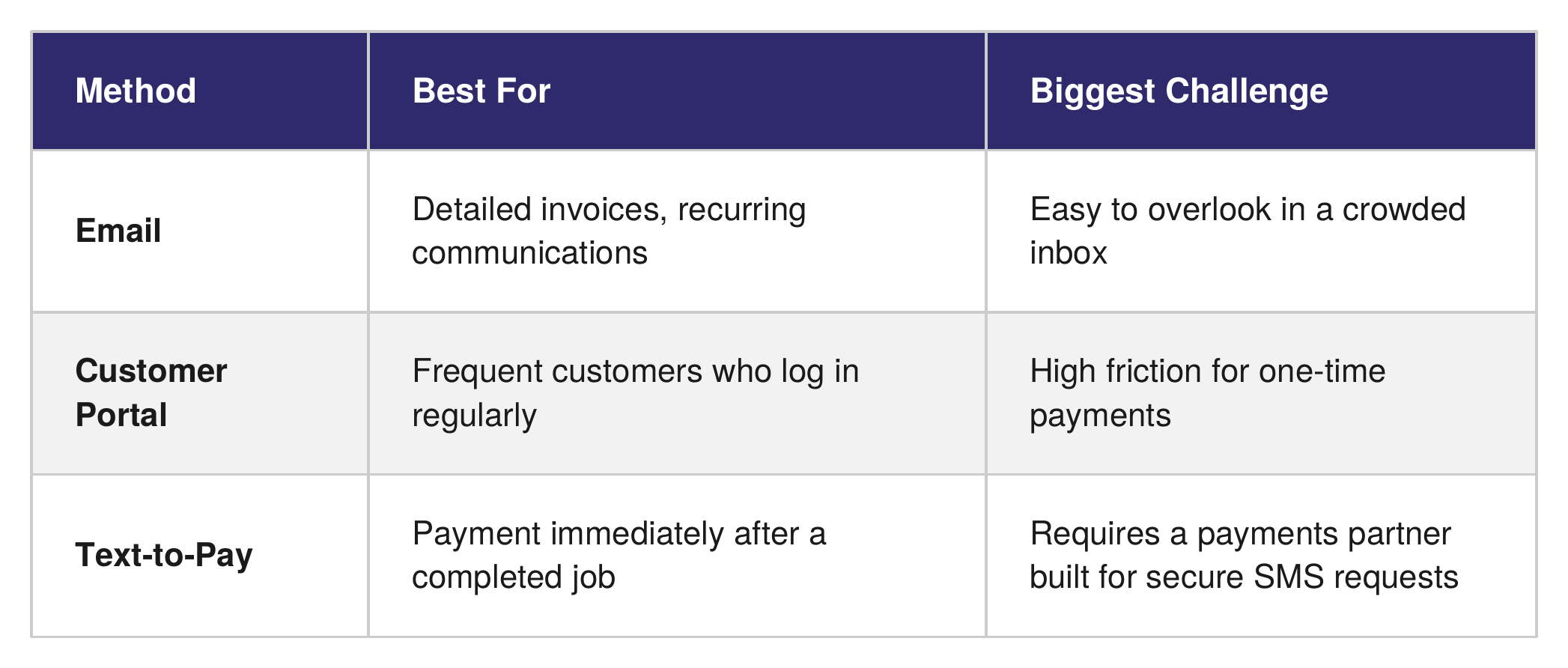
Email is the default payment request most businesses start with, and it comes with a structural disadvantage: it competes with hundreds of other emails for attention.
A technician finishes a job at 2:00 p.m. The invoice lands in the customer's inbox. They're at work, so they plan to pay it tonight. By dinner, they've forgotten. By tomorrow, it's buried under newer messages, and the business's team starts the follow-up process.
The invoice wasn't ignored on purpose. It lost its moment.
Option 2: Customer Portals
Portals solve one problem — keeping payment history organized — and create another: friction. To pay through a portal, a customer typically has to remember it exists, recall a username, reset a forgotten password, find the right invoice, and complete payment.
That works for customers who log in regularly. For someone making a one-time payment after a repair or an estimate, it's too many steps. Every additional step is a reason to put it off.
Option 3: Text-to-Pay
A text message arrives where the customer is already paying attention — no inbox to search, no portal to log into, no password to reset. The customer gets a secure payment link immediately after the job is done, while the work is still top of mind.
RevitPay's Text-to-Pay is powered by Authvia, a patented conversational payments platform that lets a technician request and collect payment by SMS, RCS, or email with no app, no login, and no additional hardware. Customers complete payment in under a minute. It supports cards, ACH, RTP, and major digital wallets including Apple Pay, PayPal, Cash App, and Paze. The platform is SOC 2 certified and HIPAA-ready, and it's built on infrastructure — including partnerships with Worldpay, Fiserv, Twilio, and the major U.S. carriers.
For the customer, paying becomes part of finishing the appointment instead of another task for later.
Why Timing Matters More Than Reminder Emails
Most businesses respond to slow payments by sending more reminders. That treats the symptom, not the cause. The better question is not, "How do we remind customers to pay?" It is, "How do we make payment easier while the job is still top of mind?"
Text-to-pay changes the timing. Instead of chasing an invoice days later, the business sends a payment request as soon as the work is complete, while the customer is still thinking about the service.
Comparing the Three Methods
FAQ: Text-to-Pay for Field Service Businesses
Is text-to-pay secure?
Yes. RevitPay's Text-to-Pay, powered by Authvia, uses PCI Level 1 and SOC 2 compliant, encrypted payment pages. No card data is ever transmitted through the text message itself — the customer taps a secure link and completes payment in a protected browser session.
How fast does a text-to-pay payment actually get collected?
Industry data shows email-based invoicing runs into weeks-long collection delays (Atradius Payment Practices Barometer, US 2024). Text-to-pay requests sent at the point of service typically collect in under a week.
Does the customer need to download an app?
No. Authvia's platform requires no app, no login, and no additional hardware. The customer receives a text with a secure payment link and pays from their phone's browser.
What payment types does Text-to-Pay support?
Cards, ACH, RTP, and major digital wallets including Apple Pay, PayPal, Cash App, and Paze.
Is this only for field services?
Field services is the strongest fit — a technician can send a request before leaving the driveway — but the same logic applies to any business collecting one-time or follow-up payments: contractors, home services, and insurance agencies among them.
The Bottom Line
Email isn't going away, and portals still have value for recurring customers. But if the goal is faster collections and fewer days of outstanding receivables, the channel that gets opened while the work is still fresh wins.
RevitPay's Text-to-Pay, powered by Authvia, is built into RevitPay's payments infrastructure — no separate app, no new login, no added hardware.
Talk to RevitPay about what a 15-minute AR review could show for your business.
.svg)
Start Your Payment Review

.svg)