Insurance AMS Payment Integrations: What Agencies Should Look For
For years, many agencies ran payments beside the AMS instead of inside it. The AMS held the policy record. The payment portal held the transaction. Accounting had to connect the two later.
That setup works. It also creates work the agency absorbs after every payment: matching deposits, fixing records, and cleaning up reports at month-end.
That is the test that matters for insurance AMS payment integrations. An AMS payment integration is valuable only if it reduces the work after the payment.
Industry groups like the IIABA and data-standards bodies like ACORD have pushed toward connected, interoperable systems for years. Payments are the latest piece catching up.
Why Payment Integrations Matter More Now
A processor used to be judged mostly on rates. Agencies now ask different questions:
- Does it run inside our AMS?
- How much reconciliation is still manual?
- Can staff work without switching systems?
- How clean is the reporting?
- Does the workflow hold up as the agency grows?
Payments touch policy servicing, trust accounting, reconciliation, carrier remittance, recurring billing, reporting, and client experience. Once an agency sees how much cleanup a disconnected setup creates, the integration question outranks the rate question.
What “Native Integration” Should Mean
Plenty of providers say they integrate with insurance systems. The word covers very different things. Some setups still rely on separate portals, manual exports, and duplicate entry. A native integration runs the payment workflow inside the AMS itself.
That difference is easiest to see side by side.
Disconnected Portal vs Native AMS Payment Workflow
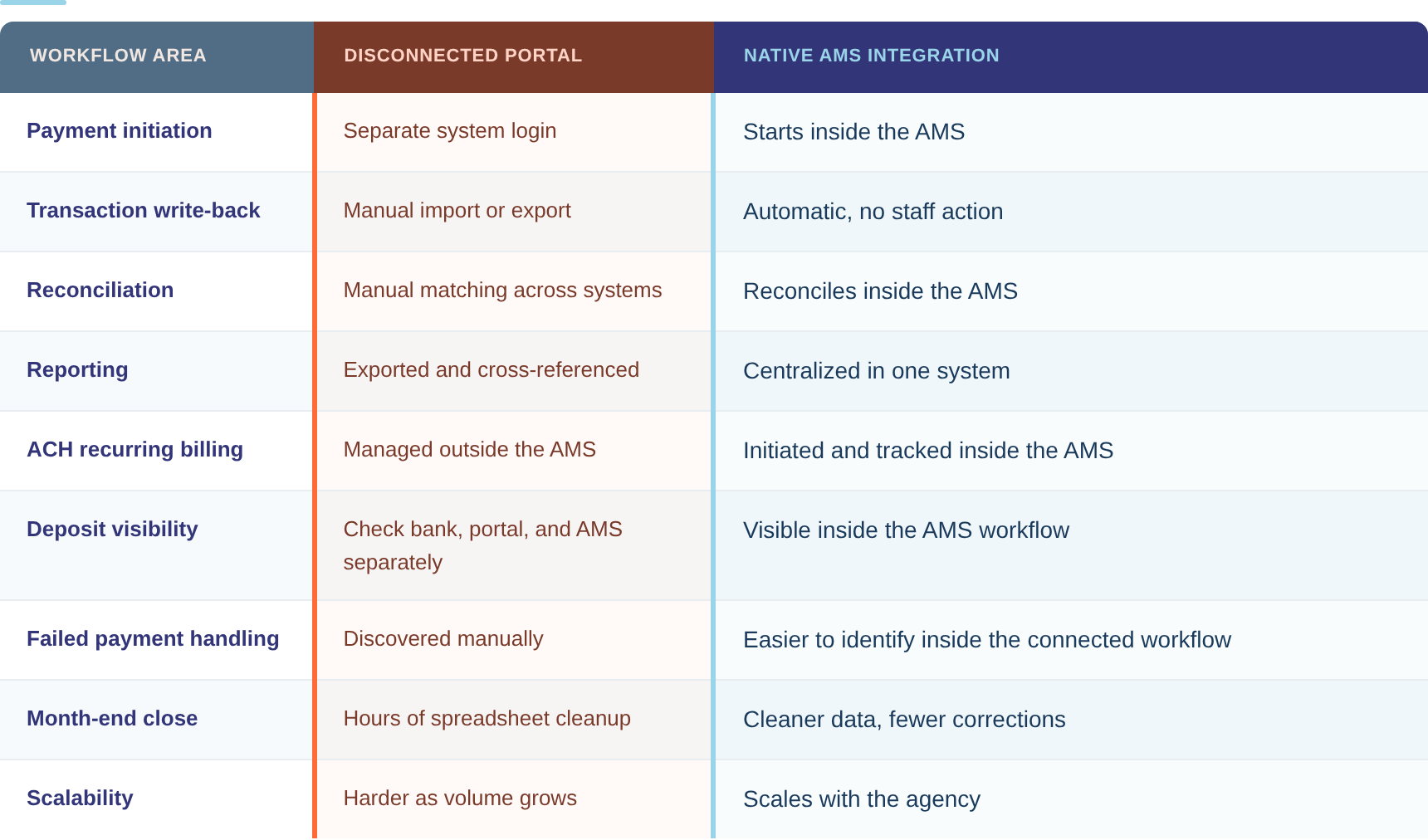
The gap widens as the agency grows. A workflow that feels fine at low volume gets heavy when premium collection, recurring billing, and month-end close all need clean data across systems that were never built to talk to each other.
How Major AMS Platforms Approach Payment Integrations
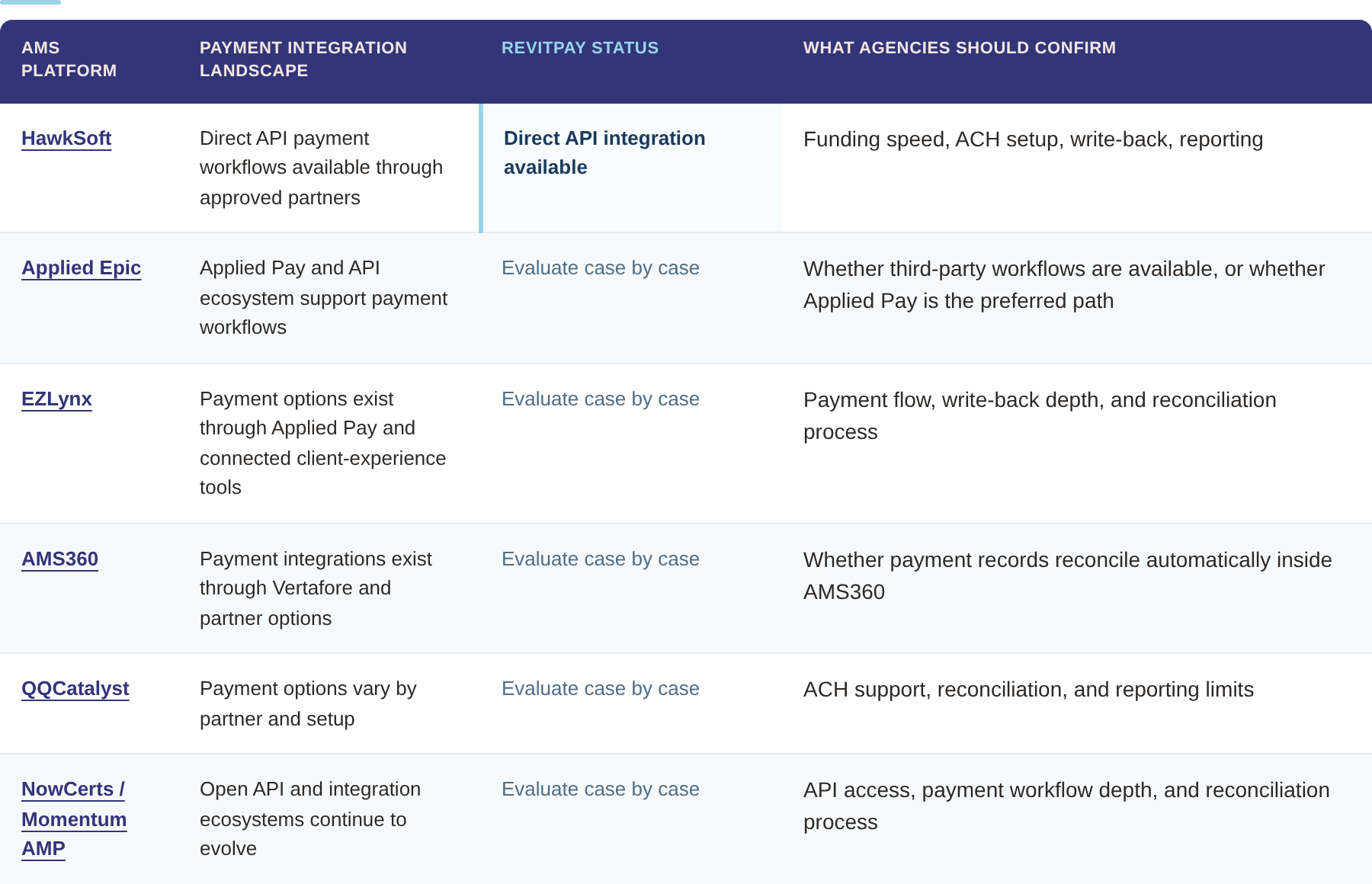
The AMS market is broad, and each platform handles payments differently. Available payment workflows vary by provider, version, and marketplace setup, so treat the table below as a starting point and confirm specifics with your AMS and payment vendor.
HawkSoft Payment Integration
HawkSoft is RevitPay's clearest AMS proof point. On March 26, 2026, RevitPay and HawkSoft launched a direct API payments integration (launch release). RevitPay's direct API integration with HawkSoft allows agencies to process payments inside HawkSoft, automate reconciliation, and improve visibility into premium collection.
For the deeper build, see the HawkSoft integration page and the breakdown of ACH for HawkSoft.
Applied Epic Payment Integration
Applied Epic is widely used by larger brokerages and multi-office operations. Applied offers Applied Pay, a payment product tied into Epic, and Epic's API ecosystem supports other payment workflows. Agencies on Epic should confirm whether third-party payment workflows are available, or whether Applied Pay is the preferred path for their setup.
EZLynx Payment Integration
EZLynx, part of Applied, is common among independent agencies wanting a streamlined workflow. Payment options exist through Applied Pay and connected client-experience tools. Agencies on EZLynx should confirm the payment flow, write-back depth, and reconciliation process before committing.
AMS360 and QQCatalyst Payment Integrations
AMS360 and QQCatalyst are both part of Vertafore. AMS360 has payment integrations through Vertafore and partner options, including providers that reconcile payments into AMS360 directly, so confirm whether payment records reconcile automatically inside AMS360. QQCatalyst payment options vary by partner and setup, so confirm ACH support, reconciliation, and reporting limits.
NowCerts and Momentum AMP Payment Integrations
NowCerts and Momentum AMP are growing in the independent agency space, both built around open APIs. Integration ecosystems here continue to evolve. Agencies should confirm API access, payment workflow depth, and the reconciliation process for any payment vendor they consider.
Why Disconnected Payment Portals Create More Work
A disconnected portal feels manageable early on. The cost shows up later: manual reconciliation, reporting that does not match, duplicate entry, deposit tracking, month-end cleanup, and staff interruptions. The bigger the agency, the more those hours add up.
That is why agencies care less about whether a processor can accept a payment, and more about what happens to the payment record afterward.
Many agencies operate under state-specific premium handling, trust accounting, and recordkeeping requirements, so payment data needs to reconcile cleanly and on time. Disconnected portals make that harder as volume grows.
What Agencies Should Evaluate Before Choosing a Payment Integration
As agencies review AMS payment integrations, the useful questions are practical. This framework moves past rate comparisons toward what determines long-term fit:
These matter far more long term than whether a processor simply offers online payments. The strongest setups treat the payment integration as a decision worth getting right, not a commodity purchase.
Where RevitPay Fits
RevitPay builds payment infrastructure around how agencies run: AMS integration, reconciliation, ACH workflows, funding visibility, and merchant support.
RevitPay's clearest AMS proof point today is HawkSoft. The direct API integration lets agencies collect card and ACH payments inside the system, reconcile automatically, and see deposits without separate tracking. On other AMS platforms, the right path depends on the platform and the agency's setup, which is what the table above is for. If you are weighing providers, the ePayPolicy vs RevitPay comparison and the insurance agency payment processing overview go deeper.
RevitPay follows PCI Security Standards Council requirements across payment workflows, the baseline for any agency handling cardholder data.
Final Take
Agencies are moving away from disconnected payment workflows. The expectation is simple: payments should run inside the systems agencies already use.
An AMS payment integration earns its place when it cuts the work after the payment: less manual reconciliation, faster month-end close, and room to grow without adding admin.
Start with the platform you run, confirm how payments reconcile inside it, and judge any integration by the work it removes.
Frequently Asked Questions
What is an insurance AMS payment integration?
An AMS payment integration lets agencies process and reconcile payments directly inside the agency management system instead of using a separate portal. Native integrations, where payments initiate and write back inside the AMS automatically, deliver the most benefit.
Why do native integrations matter for insurance agencies?
Native integrations reduce manual reconciliation, simplify reporting, and cut administrative cleanup. As premium volume grows, the time saved over a manual or portal-based setup grows with it.
Does RevitPay integrate with HawkSoft?
Yes. RevitPay offers a direct API payments integration with HawkSoft, covering card and ACH acceptance with automatic write-back into the AMS.
Why are agencies moving away from disconnected payment portals?
Disconnected systems create friction through manual reconciliation, duplicate entry, reporting that does not match, and cleanup, all of which grow with the agency. Native integrations remove most of that by keeping payment data inside the AMS from the start.
What should agencies evaluate in a payment integration?
Look at reconciliation workflow, ACH infrastructure, reporting, funding speed, dispute tools, support quality, and room to scale, not only whether the integration technically exists. How well it works day to day matters more than whether it appears on a marketplace.
Are AMS payment integrations becoming more important across the industry?
Yes. As agencies modernize, the expectation around integrated payment workflows is rising across nearly every major AMS platform, driven by open APIs and growing marketplace ecosystems.
.svg)
Start Your Payment Review

.svg)