The Effective Rate on Your Merchant Statement
There is one number on your merchant statement worth more than the rate you were sold. Your effective rate. Total fees divided by total volume, times 100. Owners quote the advertised rate from memory. Almost none know the effective rate. The difference between the two tends to run 0.3 to 0.8 percent on a normal account. Put real volume behind it and you are looking at thousands of dollars a year.
You know your advertised rate. The effective rate is the one they hope you skip.
The advertised rate showed up the day you signed. It lives on the website and in your contract, one clean figure describing one perfect transaction. Your effective rate describes the rest. Every sale you ran last month, fees and all. One number gets marketed to you. The other gets buried.
What the effective rate measures
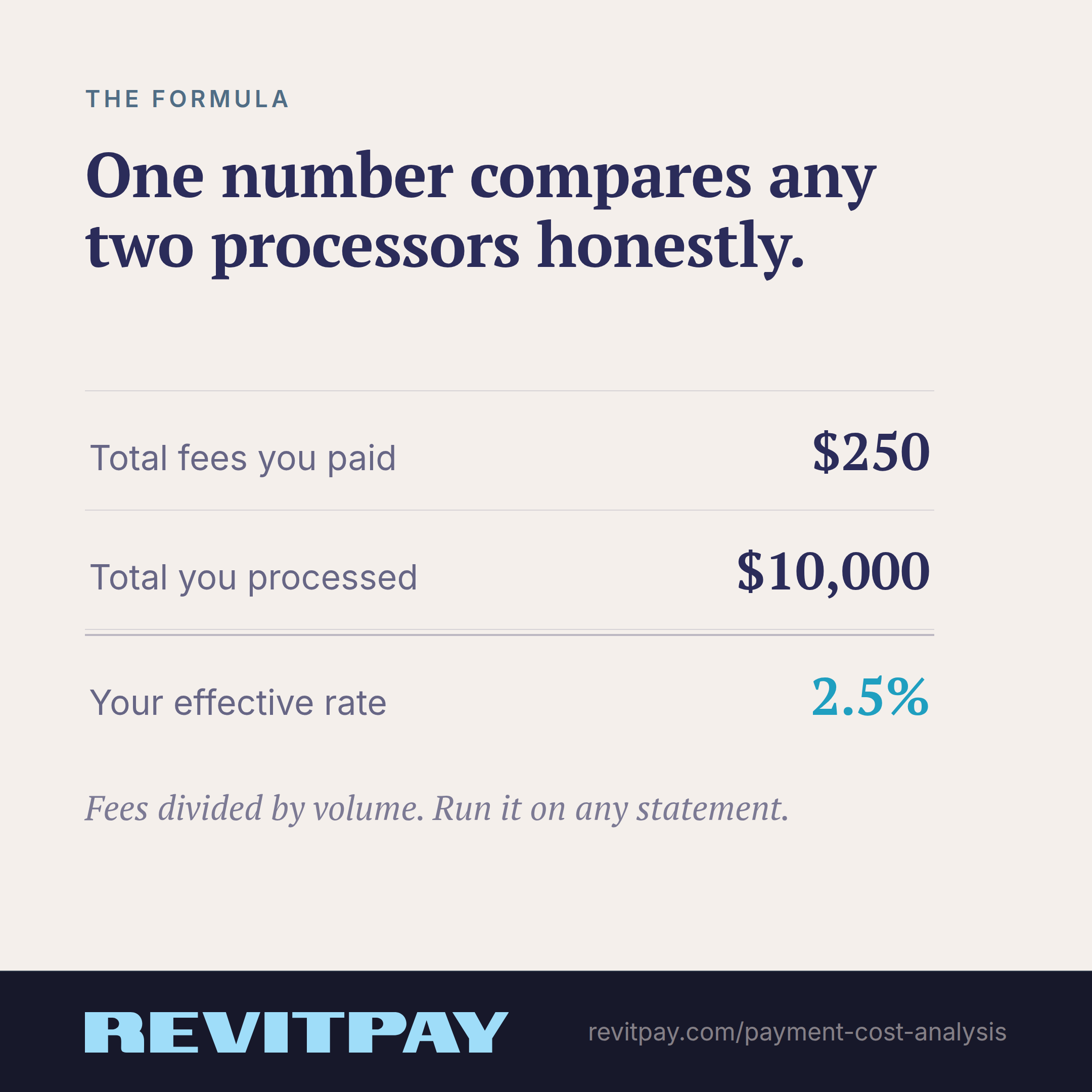
Total fees over total volume. Take every charge on the statement, divide by every dollar you processed, multiply by 100. The figure swallows everything. Interchange, assessments, the processor's markup, PCI fees, the monthly line items you stopped reading. Run it once and you have a single honest way to set flat-rate, tiered, and interchange-plus side by side. Nothing else on the page does the same job.
Why the advertised number flatters your processor
The quote assumes the best possible sale. Qualified card, tapped in person, settled same day, no extras. Your real month never matches the brochure. Rewards cards, keyed sales, downgrades, a PCI fee here, a statement fee there, and the true cost drifts up. On a normal account the drift runs 0.3 to 0.8 percent. Process 2 million dollars a year and half a point is 10,000 dollars gone.
The downgrade nobody warns you about
Every sale gets sorted into an interchange category, and the cheap categories come with strings. Clean data. Fast settlement. Address verification on keyed cards. Miss one and the network slides the sale into a pricier bucket. Most processors close the batch inside 24 to 48 hours. Run past the window and your cost rises while your statement stays silent. Stack enough downgrades and you have found a real piece of the gap between advertised and effective.

Three pricing models, and the one where your markup disappears
Flat-rate hands you one blended number, around 2.6 percent in person, resting on interchange near 1.8 percent. The space between the two is your markup, and the statement never itemizes it. Tiered sorts your sales into qualified, mid, and non-qualified buckets. The advertised rate is the cheap qualified one, but most of your volume lands in the higher tiers, where the statement does not break out the markup. Interchange-plus runs the other way. The statement prints true interchange and a fixed markup, line by line, every month. Go looking for your markup on a tiered statement and you come up empty.

What overpaying looks like in real numbers
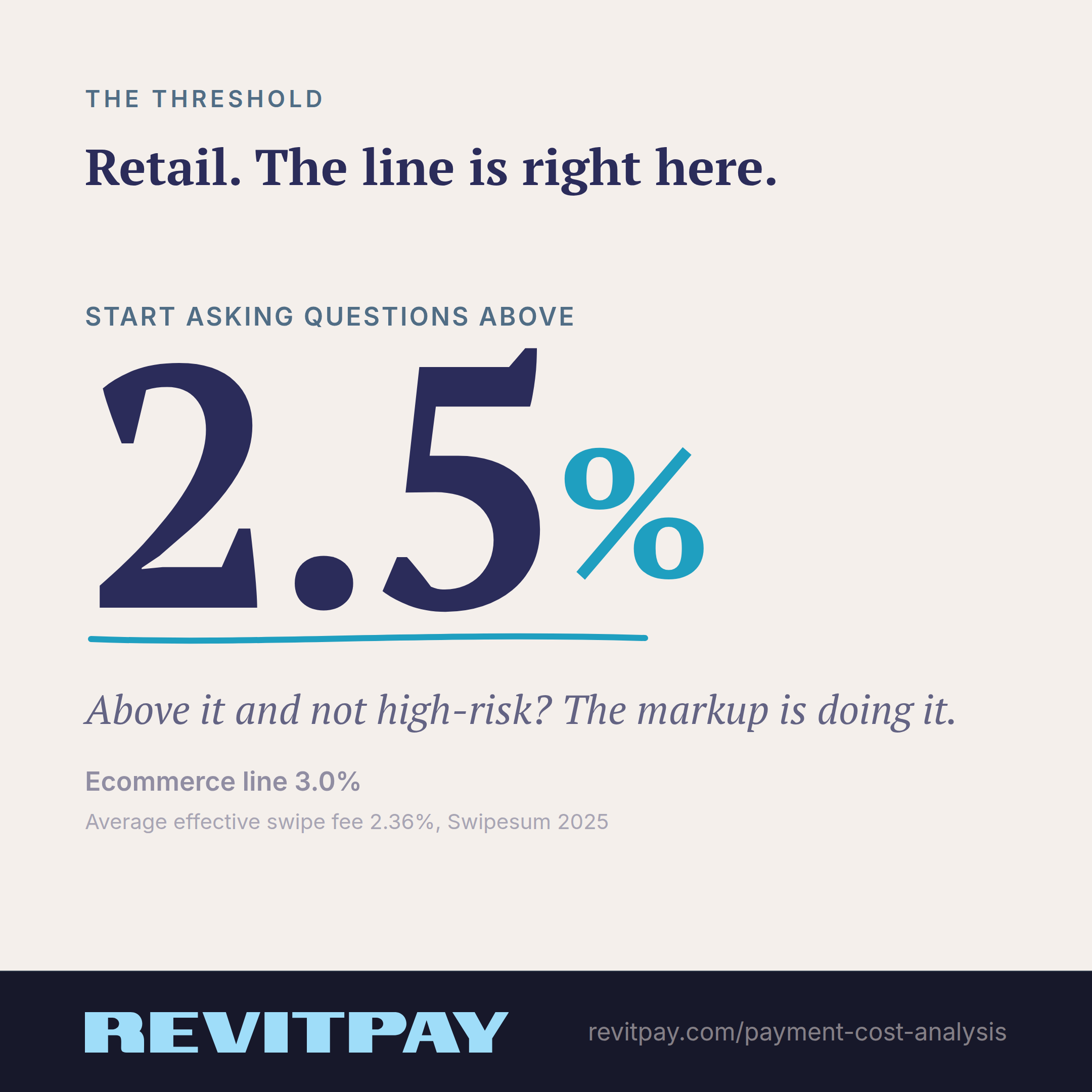
Across Visa and Mastercard, the average effective swipe fee in 2025 came in at 2.36 percent. Hold two lines in your head. Retail above 2.5 percent, you have room to cut. Ecommerce above 3 percent, same story. Higher belongs to high-risk categories and nowhere else. Sit above the line without a high-risk reason and the markup is the cause, not your customers' card mix.
Network fees are set to fall. Watch who keeps the difference.
In June 2026, a Brooklyn federal judge granted preliminary approval to a revised 38 billion dollar settlement between Visa, Mastercard, and roughly 12 million merchants. The terms trim average credit interchange by a tenth of a point, 10 basis points, for five years, and cap standard consumer card rates at 1.25 percent for eight years. Final approval is still ahead, and appeals could stretch the timeline.
Read past the headline for the part touching your statement. When the networks charge your processor less, your effective rate moves only if the processor passes the cut along. Interchange-plus passes it through on its own. Flat-rate and tiered keep the spread until you push. Processors rarely flag a rate change in your favor. So pull your statement after each interchange update and look for the drop.

The fix takes 90 seconds
No analyst, no week of waiting. Enter your monthly volume, average ticket, card mix, and current fees. Your report shows your effective rate with every step behind the number. An expert doing this by hand needs about a week. The calculator answers in about 90 seconds.
See the math before anyone sells you
You deserve the numbers before a sales call, not after. RevitPay's tool shows your effective rate and your projected costs over time. Run yours. Find out where you stand.
Run your numbers: revitpay.com/payment-cost-analysis
Frequently asked questions
What is an effective rate?
Total processing fees divided by total card volume, times 100. The real all-in percentage you pay to accept cards.
How do I calculate it?
Add every fee on your statement, divide by your total volume, multiply by 100. Example: 250 dollars in fees on 10,000 dollars in volume is 2.5 percent.
What counts as a good effective rate?
Under 2.5 percent for in-person retail, under 3 percent for ecommerce, outside high-risk categories. The 2025 Visa and Mastercard average was 2.36 percent.
Why is my effective rate higher than my advertised rate?
The advertised rate covers one ideal sale. Your real mix brings rewards cards, keyed sales, downgrades, and add-on fees. The gap runs 0.3 to 0.8 percent on a normal account.
Which pricing model costs the least?
Interchange-plus, once you clear roughly 10,000 dollars in monthly volume. Tiered is the hardest to audit and often the priciest.
How is interchange different from my effective rate?
Interchange is set by the card networks and paid to the issuing bank. Your effective rate folds in interchange, assessments, your processor's markup, and add-on fees.
Will the Visa and Mastercard settlement lower my rate?
The 2026 settlement won preliminary approval in June and would trim average interchange by a tenth of a point for five years, with a 1.25 percent cap on standard consumer cards for eight years. Your rate drops only if your processor passes the cut through. Interchange-plus does this on its own. Flat-rate and tiered hold the spread until you push.
How long does a statement analysis take?
A manual audit runs about a week. The calculator returns your effective rate in under two minutes.
Sources
Effective rate, 2025 average swipe fee of 2.36%, and the 2.5%/3.0% review thresholds:
Swipesum, The True Cost of Credit Card Processing in 2026: A Merchant's Guide
Effective rate definition and calculation:
Swipesum, A Guide to the Effective Rate in Credit Card Processing
Interchange, pricing models, markup, and downgrade mechanics:
Swipesum, Ultimate Guide to Credit Card Processing Fees
2.36% for 2025, corroborated by the Merchant Payments Coalition citing the Nilson Report:
The Motley Fool, Average Credit Card Processing Fees and Costs in America
2026 Visa and Mastercard settlement terms and preliminary approval:
Payments Dive, Court Approves Visa-Mastercard Settlement
Questions related to this guide
How much are credit card processing fees?
Credit card processing costs most U.S. businesses between 1.5% and 3.5% per transaction. The floor is interchange — the card networks' published wholesale cost — plus your processor's markup. Online and keyed transactions cost more than in-person chip payments because card-not-present fraud risk is priced into the rate.
Read full answerWhat is a merchant account?
A merchant account is the arrangement with an acquiring bank and a payment processor that lets a business accept credit and debit cards. Card sales are authorized and settled through it, fees are deducted, and the funds are deposited to your business checking account, typically within 1–2 business days. Approval involves underwriting, because the bank takes on risk for every sale.
Read full answerWhat is a payment gateway?
A payment gateway is the software that securely captures card details on your website or app, encrypts them, and sends them to the processor for authorization — the online equivalent of the card terminal in a store. Gateways also handle recurring billing, tokenization, and fraud screening before a transaction ever reaches the networks.
Read full answerWhich industries are considered high-risk?
Commonly high-risk industries include CBD and hemp, firearms and ammunition, nutraceuticals and supplements, telehealth, vape and tobacco, subscription and continuity billing, travel, coaching and info products, debt services, adult products, and pawn. Most appear on the published restricted-business lists of Stripe, PayPal, and Square — which is why those providers decline them.
Read full answerWhat documents do I need to apply for a merchant account?
A standard merchant account application asks for a government-issued ID, your EIN or business registration, a voided check or bank letter for your settlement account, and about three months of recent bank or processing statements. High-risk businesses should also expect to provide licenses, supplier agreements, and financial statements.
Read full answerCan gun shops and FFL dealers accept credit cards?
Yes. Gun shops and federal firearms licensees (FFLs) can accept credit and debit cards, and Visa says it serves any legal purchase. Paying by card does not change the dealer's federal duties: record the sale on ATF Form 4473 and contact NICS before transfer. The harder part is finding an acquiring bank willing to board the business.
Read full answerWhat is a chargeback?
A chargeback is a card payment taken back by the cardholder's bank after the cardholder disputes it. The issuing bank sends the dispute through the card network to the merchant's bank, which deducts the amount from the merchant's account. Visa's merchant rules call this a dispute. Mastercard calls it a chargeback. The process is the same.
Read full answer